       |
   
 |
 |

|
|
All photos copyrighted by Leda Avouri |

Do have a sit, get yourself comfy and enjoy the view!
Epirus

 |
| Papigo |
Epirus is without a doubt one of the most stunning provinces in Greece, and one of the most breathtaking and dramatic in Europe. Its natural landscape includes rock canyons and waterfalls, lakes and streams, and golden beaches with clear turquoise waters. This is one of the most unique regions of Greece both for nature walks and extreme activities on one hand, and short nature walks that are not strenuous, on the other. Merging all that with great food and fascinating culture makes a trip to Epirus and its subprovinces, Zagorochoria and Tsumerka, really enjoyable.
Right here is where you'll get a first taste of Epirus. But anything we might write is dwarfed by what you'll see when you actually visit. A trip there is an experience for all your senses. Epirus is the fourth largest province in Greece, the larger ones being Macedonia, Thraki and Thesalia. But none of those three offer such amazing diversity, although they certainly have their highlights.
Epirus spreads across some 9200 square kilometers between Preveza in the south west, the eastern ridge of the Pindus Mountains, and Konitsa in the north. This region boasts some of the highest peaks in Greece, such as Tsumerka and the Astraka range in the northern Zagoria villages. It’s also considered the most developed area of Greece for walking trails and serious treks.

 |
| Voidomatis river |
 |
| Ioannina lake |


All photos coryrighted by Leda Avouri
Source of Info: www.epirusgreece.gr

Philothei
I consider myself lucky as I have grown up and lived for 30 yrs in the beautiful northern suburb of Athens, that is Philothei.
The Municipality of Philothei is situated in the Attica Region and is approximately 7 klm from the center of Athens.
The community was founded in 1934 initially as a residential area for the employees of the National Bank of Greece.
The Municipality is characterized by residences alone and not shops and is thus a garden city. Its rich nature, promenade routes, and Podoniftis stream that runs through it, also adds to its beauty, not to mention available tennis court, track, scout club etc.
 |

 |
| Pikioni Playground |

 |
| Philothei's track |
The Public Gym of Philothei was created in 1954 in memory of the marathon runner Stelios Kyriakidis


 All photos copyrighted by Leda Avouri


 |
| Drosopoulou park |
 |
 |
| Podoniftis stream |


Paros island...
Paros belongs to the Cyclades Group of Islands
Paros is located in the heart of the 24 inhabited islands of the Cyclades and because of its central location, it is an ideal starting point for the exploration of Aegean. The island, which is west of Naxos and east of Antiparos, is elliptically shaped, with 168 kilometers of coastline. Ferries arrive at our island in just a few short hours, and it is well connected to multiple destinations.
The island infrastructure comprises a port, airport, marinas, public services, banks, post offices, local transportation, etc. The main port and anchorage are situated in Parikia, the capital of the island.
Naoussa and Piso Livadi both operate marinas from which excursions to Naxos and neighboring islands depart. The port of Pounta connects Paros and Antiparos. >>>>
My life in a nutshell!
My name comes
from the Greek
Mythology, from "LEDA and THE SWAN". Though I was born
in Athens, as well as my parents, our family name can be traced all the
way back to the 14th century, to the Ionian island of Zakynthos. From my dad's side, my origins are traced to Zakynthos
& Amorgos, and from my mom's side, to Pontos & Asia Minor.
Greece's Blue Flag beaches
The Blue Flag Programme is run by the independent non-profit organization Foundation for Environmental Education and is dedicated to labeling beaches and marinas appropriate for swimming. The criteria that a beach must fulfill to get a Blue Flag has to do with its cleanness, the water quality, organization, safety of the swimmers, environmental protection and other services. Usually 3,200 beaches and marinas in 37 countries are tested every year in swimming periods and normally Greece is ranked in the first three positions, among countries from Europe, Africa, New Zealand, Canada and the Caribbean. This eminence is another proof of the high-quality Greek seas that millions of tourists come every year to enjoy. Greece offers thousands of beaches. There are 395 blue flag beaches in Greece. Most Greece Blue Flag beaches are usually found in Halkidiki, on the northern side of Greece, while Dodecanese and Crete (particularly Lassithi) also gets high scores. The Ionian islands, particularly Kefalonia and Lefkada, also distinguish for their clean and organized beaches, proving that the Greek coasts have nothing to jealous out of the other famous beach resorts of the world. In 2015, 395 Greek beaches and 9 marinas have been awarded with the Blue Flag. Greece once again ranked second place on the Blue Flag quality award list among 49 countries.
Source: www.greeka.com
Source: www.greeka.com
Greek Culture
There is so much that defines a people, especially a people that has been around since the ancient times. Discover the Greek Culture...
 |
 |
|
 |
 |
 |
Greek History
|
||
 |
Greek Weddings
|
|
Greek Easter |
||
 |
Greek Coffee
|
|
Greek Cuisine
|
Nature
|
|


Zakynthos (a.k.a. Zante)
Zakynthos (Greek: Ζάκυνθος), or Zante (from Venetian) is a Greek island in the Ionian Sea. It is the third largest of the Ionian Islands. Zakynthos is a separate regional unit of the Ionian Islands region, and its only municipality. It covers an area of 410 km2 (158 sq mi) and its coastline is roughly 123 km (76 mi) in length. The island is named after Zakynthos, the son of a legendary Arcadian chief Dardanus. The name, like all similar names ending in -nthos, is pre-Mycenaean or Pelasgian in origin.
Epiphany (January 6)
This day, takes on a special meaning in Greece. Here, there is a special ceremony of blessing the waters and of the vessels that ply them. The modern observance at Piraeus, the ancient port of
Athens, takes the form of a priest hurling a large crucifix into the waters.
Young men brave the cold and compete to retrieve it. These days, the cross is generally attached to a nice, safe long chain, just in case that year's crop of divers is something less than desired.
After the diving, local fishermen bring their boats to be blessed by the priest.
What does all this have to do with Christmas? Orthodox belief says that it was the day of the baptism of Jesus, and that this is where the day's association with water arises.
This day, takes on a special meaning in Greece. Here, there is a special ceremony of blessing the waters and of the vessels that ply them. The modern observance at Piraeus, the ancient port of
Athens, takes the form of a priest hurling a large crucifix into the waters.
Young men brave the cold and compete to retrieve it. These days, the cross is generally attached to a nice, safe long chain, just in case that year's crop of divers is something less than desired.
After the diving, local fishermen bring their boats to be blessed by the priest.
What does all this have to do with Christmas? Orthodox belief says that it was the day of the baptism of Jesus, and that this is where the day's association with water arises.
Rhodes / Rodos
Historically, Rhodes was famous worldwide for the Colossus of Rhodes, one of the Seven Wonders of the Ancient World. The medieval Old Town of the City of Rhodes has been declared a World Heritage Site. Today, it is one of the most popular tourist destinations in Europe.
Lake Prespes and Pozar Thermal Waters

Prespes are two lakes in the northwestern part of Greece, in the prefecture of Florina. Megali Prespa is divided between Greece, FYROM and Albania, has an area of 270 km² and a maximum depth of 55 m. In Greece belong only 37 km². Mikri Prespa is found mainly in Greece (88%), while a small portion in the west belongs to Albania (12%) and has an area of 43 km² and a maximum depth of 8 m. The Prespa National Park was created in 1974.
Kerkyra (a.k.a. Corfu)
Kerkyra a.k.a. Corfu (info by wikipedia) is
one of the Ionian islands (Eptanisa; 7 islands) cluster, in the Ionian
Sea. It is the second largest of the Ionian Islands and, including its
small satellite islands, forms the edge of the northwestern frontier of
Greece.
The island is part of
the Corfu regional unit, and is administered as a single municipality.
The municipality includes the island Corfu and the smaller islands
Ereikoussa, Mathraki and Othonoi. The principal city of the island and
seat of the municipality (pop. 33,886) is also named Corfu.
Christmas
St. Nicholas is important in Greece as the patron saint of sailors. According to Greek tradition, his clothes are drenched with brine, his beard drips with seawater, and his face is covered with perspiration because he has been working hard against the waves to reach sinking ships and rescue them from the angry sea. To members of the Eastern Orthodox Church, as are most Greek Christians, Christmas ranks second to Easter in the roster of important holidays. Yet there are a number of unique customs associated with Christmas that are uniquely Greek.
On Christmas Eve, children travel from house to house offering good wishes and singing kalanda, the equivalent of carols. Often the songs are accompanied by small metal triangles and little clay drums. The children are frequently rewarded with money whereas in earlier times they were given sweets and dried fruits. After 40 days of fasting, the Christmas feast is looked forward to with great anticipation by adults and children alike. Pigs are slaughtered and on almost every table are loaves of christopsomo ("Christ Bread"). This bread is made in large sweet loaves of various shapes and the crusts are engraved and decorated in some way that reflects the family's profession.
In Greece they would decorate a little boat and Christmas trees back in the days were not commonly used in Greece, but today every house has one. Gifts are exchanged on St. Basil's Day (January 1). Also they break a pomegranate for good luck on January 1st.
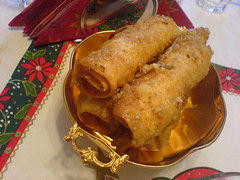
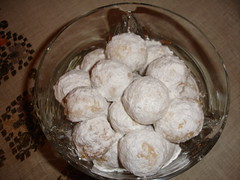
It's kourabiedes time again, and the mellow aroma of melomacarona cookies and diples will soon be filling Greek kitchens worldwide.


Epiphany (January 6)
This day, takes on a special meaning in Greece. Here, there is a special ceremony of blessing the waters and of the vessels that ply them.
The modern observance at Piraeus, the ancient port of Athens, takes the form of a priest hurling a large crucifix into the waters. Young men brave the cold and compete to retrieve it. These days, the cross is generally attached to a nice, safe long chain, just in case that year's crop of divers is something less than desired.
After the diving, local fishermen bring their boats to be blessed by the priest.
What does all this have to do with Christmas? Orthodox belief says that it was the day of the baptism of Jesus, and that this is where the day's association with water arises.
In Greek: Στα Θεοφάνεια (επίσης Θεοφάνια ή Φώτα), που εορτάζονται στις 6 Ιανουαρίου, τιμούμε και θυμόμαστε την Βάπτιση του Ιησού Χριστού. Η λέξη Θεοφάνεια σημαίνει φανέρωση/αποκάλυψη του Θεού και αναφέρεται στην φανέρωση της Αγίας Τριάδας που έγινε κατά την Βάπτιση του Χριστού.
Σήμερα τα φώτα και ο φωτισμός.
Η χαρά μεγάλη και ο αγιασμός.
Κάτω στον Ιορδάνη τον ποταμό
κάθετ' η κυρά μας η Παναγιά.
Καλημέρα! Καλημέρα!
Καλή σου μέρα αφέντη με την κυρά!
Καλημέρα! Καλημέρα!
Καλή σου μέρα αφέντη με την κυρά!
Makedonia: Nympheo and Arcturos
Makedonía, is a geographical and historical region of Greece in southeastern Europe. Macedonia is the largest and second most populous Greek region. The region and that of Thrace are often together referred to informally as northern Greece. It incorporates most of the territories of ancient Macedon, a kingdom ruled by the Argeads whose most celebrated members were Alexander the Great and his father Philip II.
Naxos (Cyclades islands)
Naxos Island (text by http://www.naxos-island.biz) is the largest and most fertile of the Cyclades. Due to
its important agricultural production, it was one of the
latest to open itself to tourism. For that reason, it has
kept its authentic beauty which attracts every year more
and more visitors. Naxos has a great variety of
things to offer to the visitor: impressive mountainous
landscapes with many isolated traditional villages, some of
Europe’s most beautiful golden sandy beaches, a charming
capital with its Venetian quarter, picturesque fishing
villages, many Byzantine churches, ruins, active night life...
Greek Dance
Dancing has always been important to the Hellenic (Greek) people. In ancient times, dance, song, and music were all integral parts of the theater. In fact, the Greek word 'ΧΟΡΟΣ', (HOROS), referred to both dance and song. The English words chorus, chorale, choir, and choreography all come from this same Greek word. Furthermore, there are numerous references to dancing in ancient literature.
Assumption - August 15th
On the 15th of August the Greeks celebrate the Virgin Mary
Assumption Festival
Assumption Festival
Tinos is the very special Aegean island where thousands and thousands of devout pilgrims make their way every summer to pay homage in a large, celebrated gathering called, The Assumption of the Virgin. On the 15th of August, a virtual army of believers descend upon this small, rocky Cycladic isle to receive blessings, make solemn promises or give personal offerings to the Icon of Virgin Mary. Tinos is a spiritual center of modern Greece, where pilgrims gather each August to worship the Virgin Mary. In the early 1800's a vision of the Virgin Mary appeared to one of the local nuns and told her to dig in a particular location for a lost icon of herself. The icon of Virgin Evangelistria was discovered and is housed to this day in the Church of the Virgin. Every year thousands of pilgrims journey to kiss the icon, to ask for healing or in gratitude for miracles received. It is a moving spectacle when local worshippers carry the icon though the streets on Assumption Day-August 15th.
From the harbor of Tinos, a wide cobbled street leads up to a mound on which the magnificent chruch called, the Church of the Panagia, or Church of the Megalochari. Here, perched on the top, the stately chuch sit imposingly, towering above the whole town and harbour. Built out of marble from quarries at Tinos and Paros, this is the very spot where the miraculous icon of the Panagia (Virgin Mary) was discovered hundreds of years ago.
The miracle-working of the Holy Icon of the Annunciation of Tinos has been known all over the world. Thousands of Christians who come from every part of the world to feel its miraculous influence and help them in the difficult moments of their lives. The impressive church of Megalohari itself, was built after an event in 1822, when a Sister by the name of Pelagia, who was a nun at Moni Kechrovouniou had a vision of Virgin Mary that revealed to her where an icon depicting Mary and an Archangel was to be found. Early the next year, the icon was finally discovered close to the ruins of a byzantine church which had been apparently buried in an underground vault for nearly 850 years. The actual crypt where the icon was found, is now called the Chapel of Evresis (Chapel of discovery). After this, Sister Pelagia herself was canonized and is now called, Agia Pelagia.
Since the discovery of the icon, the sacred Church of the Megalochari has been internationally recognized as a place of pilgrimage, and also known as a philanthropic organization. During the actual ceremonies, the spiritual emotion and the mystical atmosphere is apparent among the masses of believers when the Great Feast of the Virgin takes place. For believers, it is a moving experience to take part in the gathering of the faithful. Even those who are not Christian and know very little about the workings of the actual Holy Icon find themselves touched by the events. From this experience, many foreigners who visit the island leave with fond memories of the Church of the Holy Virgin, which like a divine crown, adorns and watches over the town.
VIRGIN MARY'S SNAKES
On the island Kefalonia (on the Ionian Sea), every year around the midle of August, one can see snakes crawling to a particular church. At the ruins of the old church steeple, in the villages of Markopoulo and Arginia, the miraculous snakes of Virgin Mary start appearing on August 6th. They remain at the church area until the night of August 15th when they disappear. The snakes are completely harmless for visitors. A cross on the head is their characteristic feature.
The snakes crawl on the icon of the Virgin Mary, the church filled with people and the priest holding the service but the snakes have no fear, they are there around people's feet and looking to crawl on to the icon, as soon as the festivity is over they dissapear and regain their normal behaviour.
A rather peculiar detail is that they never appear on any other period than between August 6-15th. According to legend, in the 16th century, during a raid from the Pirate Barbarossa, the nuns at the Convent prayed to the Virgin Mary to save them. They were transformed into snakes. Interestingly enough, there were only two times in history that the snakes did not appear: during the German occupation and in 1953, the year of the disastrous earthquake.
The snakes crawl on the icon of the Virgin Mary, the church filled with people and the priest holding the service but the snakes have no fear, they are there around people's feet and looking to crawl on to the icon, as soon as the festivity is over they dissapear and regain their normal behaviour.
A rather peculiar detail is that they never appear on any other period than between August 6-15th. According to legend, in the 16th century, during a raid from the Pirate Barbarossa, the nuns at the Convent prayed to the Virgin Mary to save them. They were transformed into snakes. Interestingly enough, there were only two times in history that the snakes did not appear: during the German occupation and in 1953, the year of the disastrous earthquake.
Subscribe to:
Posts (Atom)